

Best Case Time Complexity of Binary Search Explained
🔍 Understand the best case time complexity of binary search, its working, and conditions for optimal performance. Learn practical computing uses with clear examples.
Edited By
Liam Matthews
Binary search is a widely used algorithm for quickly finding an element within a sorted list. Its efficiency makes it popular in various domains, including finance and stock analysis, where quick decision-making can save substantial money or time. To understand how well binary search performs, especially when analysing Indian financial data or cryptocurrency price lists, it’s essential to grasp the concept of average case time complexity.
Unlike best case or worst case, average case time complexity measures the typical performance—how many steps binary search takes on average to find an element or determine its absence. This insight helps traders and analysts estimate response times for large datasets during real trading scenarios rather than just relying on extreme cases.

Binary search divides the sorted list in half repeatedly, comparing the target value with the middle element at each step. The number of comparisons reduces dramatically compared to linear search, where every element is checked sequentially. Average case analysis calculates the expected number of these division steps given a realistic distribution of search queries.
Understanding the average case helps software developers optimise trading and investment platforms, ensuring smooth user experiences even during volatile market hours.
It assumes a uniform probability of searching for any element in the list.
For a list of size n, the average case for binary search is generally around (\log_2 n) comparisons.
This logarithmic time complexity means doubling the data size increases comparisons by only one step, making binary search particularly efficient for large financial data.
For example, consider a database of 1 million stock prices updated daily. Binary search can locate a specific stock price in about 20 steps on average—since (\log_2 1,000,000 \approx 20). Compare this to linear search, which may require up to 1 million checks in the worst case.
In India’s rapidly expanding fintech ecosystem, where platforms like Zerodha or CoinDCX handle millions of transactions, applying algorithms with good average case time complexity directly impacts user satisfaction. Faster searches lead to quicker order placements and better price discovery.
Next, we will break down how this average case is calculated and compare it against best and worst cases to appreciate its practical relevance.
Binary search plays a vital role in search-related functions where speed and efficiency matter. This method significantly reduces the number of comparisons compared to linear search, which is crucial when dealing with large datasets, such as financial records or market data in trading platforms. Understanding its basics is essential, especially when analysing its time complexity and its real-world impact on software and apps.
Binary search only works on a sorted array — this condition is non-negotiable. If the array isn’t sorted, the method loses its efficiency because the dividing strategy relies on knowing the order of elements. For example, in a stock trading app, the list of company symbols must be arranged alphabetically or based on market capitalisation before applying binary search to locate a particular stock quickly.
Without this sorted order, you’d have to scan through every entry, defeating the purpose of a quick search. This requirement itself demands prior sorting or maintaining arrays with insertion methods that keep them sorted, which is a key consideration when implementing this algorithm.
Binary search divides the sorted array into halves repeatedly to find the target value. It begins by checking the middle element; if this value matches what you’re looking for – say, the price of a specific share – the search ends immediately. If the middle element is greater than the target, the search continues in the left half, otherwise, it proceeds to the right half.
This halving continues until the target is found or the search space is empty. This process drastically cuts down the search time. For instance, locating a particular transaction entry among millions becomes faster with this approach, improving performance and user experience.
Binary search is a staple in databases and indexing systems where rapid data retrieval is paramount. For stock exchanges tracking thousands of companies, binary search helps servers quickly fetch data about a specific stock symbol or transaction.
Database indices, often organised as sorted arrays or B-trees, rely on binary search for swift lookups. This ensures traders get near real-time data, crucial for decision-making under volatile market conditions.
In Indian software development, binary search is frequently used in scenarios like implementing autocomplete suggestions in trading apps or filtering user transactions within mobile wallets. Since many users access services on low-end smartphones, optimising search speed reduces battery drain and data usage.
Also, by reducing response times, binary search helps maintain smooth interfaces—important for applications where delays could cause missed trading opportunities or affect user confidence.
Efficient search is not just about speed but also ensuring resources are used wisely, especially on mobile platforms prevalent in India.
In summary, this overview sets the foundation to appreciate the significance of analysing binary search's average case time complexity, linking theory and real-world use cases relevant to investors, traders, and financial analysts.
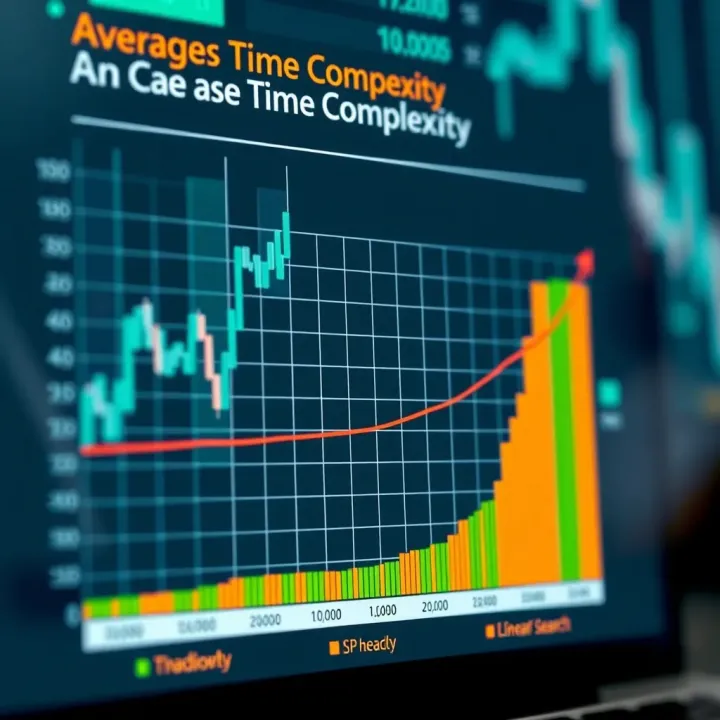
Time complexity helps you understand how fast an algorithm runs as the input size grows. It measures the number of operations an algorithm performs relative to the input size, usually represented as n. For example, if an algorithm's time complexity is O(n), doubling the input roughly doubles the time taken. This gives a practical idea of performance, especially when dealing with large data sets like stock prices or transaction logs.
Measuring algorithm efficiency through time complexity allows developers and analysts to predict how programs behave under different conditions, helping to avoid slowdowns during critical tasks. Consider searching for a stock in a list of a million tickers; using an algorithm with poor time complexity could cause noticeable delays.
Time complexity quantifies how the running time of an algorithm changes with input size. It abstracts away machine speed or programming language, focusing on the algorithm's steps. This helps in making fair comparisons between different algorithms. For instance, between linear search and binary search, their time complexities offer a way to decide which one will generally perform better for sorted data.
In practice, understanding time complexity is vital for computer science and software development. It guides decision-making when choosing algorithms, optimising code, and planning resource usage, all of which matter in high-frequency trading platforms or real-time data analytics.
Computer science uses time complexity as a foundational measure to classify algorithms and solve practical problems efficiently. For example, stock trading platforms rely on quick search algorithms to fetch data instantly; knowing the time complexity ensures these platforms remain responsive.
Without such analysis, programs might slow down unpredictably with increased data volumes, affecting user experience and system stability. Hence, time complexity analysis is integral to developing robust, scalable software suited for India's growing digital economy.
The best case scenario considers the minimum time an algorithm takes to complete, assuming ideal input. For binary search, this occurs if the target element is located at the midpoint of the array on the first check. Although this case shows the algorithm's potential speed, it rarely reflects everyday performance.
The worst case is where the algorithm takes the most time, such as when the searched element lies at the end or is absent entirely. For binary search, this means repeatedly halving the list until only one element remains, resulting in O(log n) time. Worst case helps prepare for heavy workloads, ensuring systems handle peak stress.
Average case time complexity calculates expected running time across all possible inputs, assuming they are equally likely. It offers a realistic picture of typical performance. For binary search, the average case is also O(log n) but involves weighted probabilities of where the element may be found.
Average case analysis matters most in practice, as it reflects day-to-day usage better than best or worst cases. Traders and analysts benefit by understanding expected search times rather than extremes.
This understanding allows developers to optimise algorithms knowing what to expect on average. In Indian financial apps, where data sets and user queries vary widely, average case performance ensures smooth functionality without over-provisioning resources.
To analyse average case time complexity, we begin by assuming that the target element is equally likely to be at any position in the sorted array. This uniform probability assumption simplifies understanding how many comparisons binary search makes on average before finding the element. In reality, while some positions might be accessed more often, this assumption provides a practical baseline for expected performance.
For instance, when querying a stock symbol in a sorted list of trading tickers, each ticker might be accessed equally often, making this assumption relevant. Without such groundwork, calculations would become unwieldy or rely heavily on background distribution data that is often unavailable.
Mathematically, average case complexity of binary search can be derived using recurrence relations. At each step, the search operates on half the array, leading to a recursive formula that captures the expected number of comparisons. Solving this relation shows that, on average, binary search makes about log₂ n comparisons, where n is array size.
This insight reassures developers and analysts estimating load times or algorithm costs in software or mobile apps. Knowing that average time complexity grows logarithmically helps assess that searching a list of 1,00,000 stock entries would require roughly 17 comparisons, a number manageable in real-time trading platforms.
Though the worst-case and average-case time complexities are both logarithmic, they look quite close because both occur under conditions that explore many array elements. The worst case happens when the element is at the extreme ends or absent, forcing all search steps. Average case assumes uniform distribution, which still leads to deep searches half the time, making average and worst times comparable.
This proximity matters when optimising for user experience in Indian fintech apps, where unpredictable query loads demand consistent performance. Developers often budget for worst-case scenarios to avoid lag, understanding that average cases do not stray far from those limits.
In most practical situations, binary search performs close to its average case, offering a reliable and efficient search method. Unlike linear search, which scales linearly with data size, binary search ensures rapid searches even in extensive data sets frequently used by investors analysing vast financial records.
That said, factors like data structure updates, caching, or branching in real-world software may slightly affect timings. Still, the logarithmic nature remains dominant. Thus, traders and developers can design systems confident that binary search won't be a bottleneck for timely data retrieval.
Average case analysis provides a practical performance expectation, crucial for optimizing search-heavy applications in India's fast-growing financial tech sector.
Grasping the average case time complexity of binary search matters a lot when it comes to real-world software development. It helps developers estimate the typical performance of search operations, not just the extremes. This understanding guides better optimisation and builds user-centric applications that feel fast even on less powerful devices.
Optimising search-related functions: When developers know the average case complexity of binary search, they can fine-tune search functions to run efficiently under usual loads rather than just peak scenarios. For example, a financial app that fetches historical stock prices from a sorted database benefits from knowing how many comparisons it typically takes. This allows smarter caching strategies and reduces unnecessary data retrieval. Imbalanced optimisation focusing too much on worst-case might waste resources, so average case insight leads to more balanced and practical improvements.
Effect on user experience and loading times: Search functions significantly impact app responsiveness. Average case analysis informs approximate loading delays under normal conditions, not just rare worst-case delays. For users in India using budget smartphones or slower internet, even a minor delay affects satisfaction. Developers can prioritise ways to keep the usual search experience snappy, improving overall app ratings and retention. For instance, during a large festive sale, an e-commerce app uses these metrics to ensure product searches remain smooth despite large inventories.
Constraints in mobile and low-end device usage: Many Indian users access apps on entry-level smartphones with limited RAM and processing power. Knowing average case performance helps choose search methods that won't drain battery or hog memory unnecessarily. Binary search’s predictable logarithmic behaviour makes it preferable over linear search for large datasets, but understanding its real average cost helps decide if simpler alternatives might be better in constrained scenarios, such as quick contact lookups.
Balancing speed and resource consumption: In India, apps must strike a fine balance between delivering speed and conserving data, battery, and processing power. Applications like mobile banking or stock trading apps use average case time complexity to balance smooth user experience with minimal resource use. Optimising search algorithms with average case insights avoids over-engineering, keeping the app lightweight and responsive on low-end devices without compromising on speed under typical usage.
Understanding the average case time complexity bridges the gap between theory and real-world performance, ensuring technology works well for diverse Indian users across device capabilities and network conditions.
Comparing binary search with other search methods is essential to understand where each technique fits best, especially when dealing with varied data sets and computing resources. Traders and financial analysts often rely on fast retrieval of stock prices or cryptocurrency data, where choosing the right search method can literally save seconds, impacting decision-making. This section highlights how binary search stacks up against linear search and hashing, giving you a practical view suited to Indian tech environments.
Linear search scans each item one by one, making it straightforward but inefficient for large or sorted data. It works well when data is small or unsorted, such as scanning a day’s trade logs manually. On the other hand, binary search demands a sorted array but excels when datasets are large — for example, searching through a sorted list of NSE stock symbols. In such cases, binary search provides a more scalable and reliable option.
Linear search runs in O(n) time, meaning the time increases proportionally with the data size. If you have 1 lakh stock entries, it might need to check every one before finding the target — not ideal when you need quick results. Binary search operates in O(log n) time; with the same 1 lakh entries, it will find the stock in about 17 comparisons only, which translates to faster screens and better responsiveness for trading apps.
Hashing generally offers near O(1) average time search, beating binary search in speed, especially on large datasets. However, it needs additional space for hash tables and deals poorly with collisions. Binary search, with O(log n) complexity, requires less extra memory and behaves predictably. For financial data where consistent performance is critical — say, retrieving balance details in banking apps — binary search’s predictability can be an advantage.
Indian fintech apps often use hashing for quick authentication or transaction lookups, benefiting from high-speed access. Binary search finds its place in reporting tools analysing sorted historical price data, where memory constraints limit large hash tables. For instance, a brokerage app might hash user data for login but use binary search to fetch sorted portfolio details efficiently, balancing speed and resource use.
Understanding the strengths and limits of each search method helps build efficient, responsive software tailored for Indian markets and users.
To sum up, selecting between linear search, binary search, or hashing depends on your dataset size, sorting, memory availability, and speed requirements in the financial domain. Binary search strikes a fine balance for sorted data with moderate memory needs, making it a valuable tool for stockbrokers and crypto platforms dealing with real-time data demands.
🔍 Understand the best case time complexity of binary search, its working, and conditions for optimal performance. Learn practical computing uses with clear examples.

🔍 Understand time complexity in linear and binary search algorithms! Learn how they work, compare efficiency, and pick the right search for your data.

Explore the time complexity of building and searching Optimal Binary Search Trees 🧠. Understand dynamic programming’s role and algorithm efficiency 🔍.
🔍 Understand binary search: its time and space complexity, comparison with other methods, factors affecting efficiency & scenarios where it's preferred in real applications.
Based on 15 reviews