

Time Complexity of Linear vs Binary Search Explained
🔍 Understand time complexity in linear and binary search algorithms! Learn how they work, compare efficiency, and pick the right search for your data.
Edited By
Isabella Morgan
Binary search is a fundamental algorithm used to search for an element in a sorted array or list. Its efficiency stems from repeatedly dividing the search space in half, which drastically reduces the number of comparisons compared to linear search. Understanding its best case time complexity is essential for traders, investors, and financial analysts who often deal with sorted datasets—like ordered stock prices or historical cryptocurrency values.
Best case time complexity refers to the scenario where the target element is found in the very first comparison itself. This means the algorithm locates the desired value immediately upon checking the middle element of the sorted data. In such a case, the time complexity is O(1), indicating constant time regardless of the dataset size.

Consider a stock broker accessing the mid-value of a sorted list of shares to find the price point requested by a client. If this mid-value matches the client's query, the search completes instantly, illustrating the best case. This contrasts with average or worst cases, where multiple divisions and comparisons are necessary.
Performance benchmarks: Gives a baseline for the fastest possible search time.
Algorithm optimisation: Helps in understanding when binary search performs optimally.
Real-world applications: For financial applications, recognising scenarios favouring quick results saves time and computational resources.
By appreciating the best case time complexity, professionals can design better data structures and set realistic expectations for search performance when handling voluminous financial data like market indices or crypto portfolios.
Understanding the binary search algorithm is essential, especially for traders and analysts dealing with vast amounts of sorted data, like stock prices or cryptocurrency transactions. This algorithm is a powerful tool that quickly locates a target item within a sorted list, making it highly relevant in financial software, trading platforms, and data analysis tools.
Binary search operates on the divide and conquer principle by cutting the search space in half at each step. Instead of scanning every element one by one, it focuses only on the relevant portion. For example, if you want to find a stock with a specific price in a sorted list, you compare the middle element to the target price. If it's higher, you discard the upper half; if lower, the lower half. This method keeps narrowing down possibilities rapidly, which is vital when handling large datasets.
Binary search requires the array or list to be sorted beforehand. Without sorting, the algorithm can't decide which half to discard reliably. Imagine trying to locate a particular share price in a random unsorted list — binary search wouldn't work efficiently. Sorting ensures predictability and allows quick halving of the search space, something linear search can’t do as it checks each item sequentially without assumptions.
The binary search process starts by identifying the middle element of the array. If this matches the target, the search ends instantly. If not, depending on whether the target is smaller or larger, binary search eliminates half of the elements and repeats the check in the remaining half. This continues until the target is found or the remaining search space is empty. This stepwise halving drastically reduces the number of comparisons, which is crucial for time-sensitive trading decisions.
A sorted array is the backbone of binary search. Without sorted data, this algorithm can lead to incorrect results or inefficiency. Financial datasets like stock tickers or historical price data often come pre-sorted by timestamp or price, making them suitable candidates for binary search. If data changes frequently, as in live markets, it may need regular sorting or data structures that maintain order, such as balanced trees.
While linear search checks each element from start to finish, binary search skips large chunks and focuses on halves. For example, to find a price in a list of 1 lakh sorted entries, linear search might scan upto all 1 lakh, whereas binary search would take about 17 checks (since 2^17 ~ 1,31,072). This efficiency cuts down latency, a huge advantage in trading platforms where milliseconds matter.
Binary search is like having a shortcut in a labyrinth of data — it’s precise, swift, and scales well with volume, provided the data is neatly arranged.
In sum, mastering the binary search algorithm helps traders and analysts run efficient queries on sorted datasets, ensuring faster decisions and smoother system performance.
Understanding time complexity is essential for evaluating how efficient an algorithm is, especially when handling large datasets or time-sensitive operations. In this article’s context, grasping the concept of time complexity helps decipher why binary search stands out in certain situations and how quickly it can locate a target in a sorted list.
Time complexity essentially measures the runtime of an algorithm relative to the size of the input, typically denoted as 'n'. For anyone involved in trading or financial analysis, where quick data retrieval from large databases can directly impact decisions, this metric is practically important.
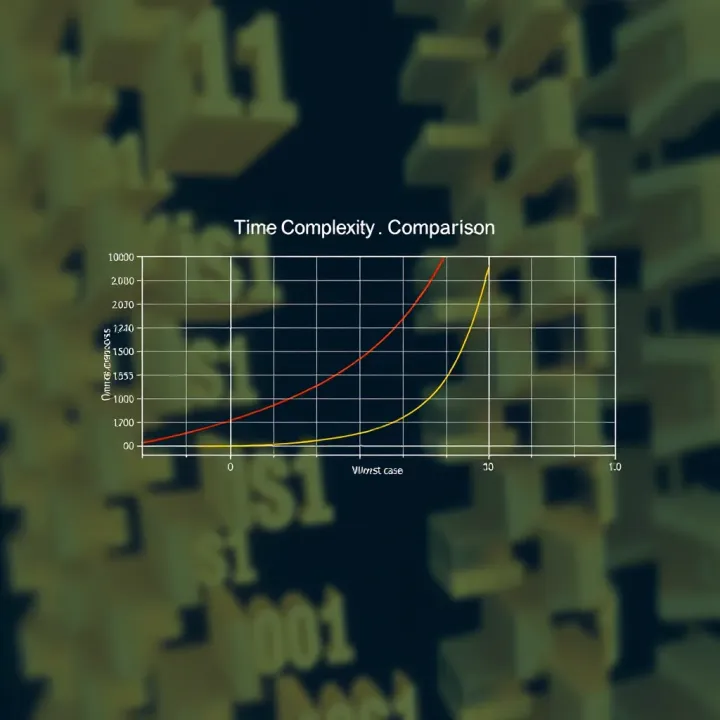
Time complexity reflects how the computational time grows as the input size increases. For example, if you have a sorted list of stock prices during the last financial year, knowing whether your search method takes a fixed amount of time or grows linearly with the data size can influence the choice of algorithm.
Simply put, an algorithm with low time complexity will handle larger datasets faster, which is why efficiency matters. This helps investors or analysts avoid delays when querying market data or running real-time simulations.
Big O notation summarises the upper limit of an algorithm's growth rate, providing a worst-case scenario of time consumption. It abstracts away machine-specific details and focuses on behaviour as input size increases.
For instance, an O(n) algorithm means the runtime increases linearly with input size, while O(log n) suggests the runtime grows much slower, logarithmically. Binary search has a time complexity of O(log n), highlighting its efficiency over linear search methods.
Best case: This indicates the most favourable scenario where the algorithm performs the least number of operations. In binary search, it occurs when the target is found in the very first comparison, resulting in constant time, or O(1). Understanding this helps in recognising conditions that play to an algorithm’s strength and when it delivers peak performance.
Average case: This represents the expected time an algorithm will take over all possible inputs. For binary search, the average case time complexity is O(log n), reflecting typical usage in real-world applications like query processing in stock trading systems.
Worst case: This outlines the maximum time an algorithm could require, important for risk assessment and system design. In binary search, the worst case is when the target is absent or located at the far end, also resulting in O(log n) time. Considering the worst case ensures preparedness for less favourable outcomes.
Recognising these different time complexities helps traders and analysts choose algorithms that balance speed and reliability, tailored to their specific data challenges.
By mastering time complexity, you can better appreciate binary search's efficiency and apply it wisely in your tools for market analysis or data retrieval systems.
The best case happens when the value you're searching for is located right at the middle of the sorted array, allowing immediate detection. Imagine a stock price list sorted by values; as soon as the binary search checks the middle entry, it matches the sought price, ending the search. This scenario, while ideal, depends on the target being perfectly positioned, which is sometimes rare in real trading data but worth understanding nonetheless.
Immediate success means the algorithm runs in the shortest possible time – just one comparison. For financial analysts running repeated searches, an occasional instant find can speed up decision-making, especially during high-pressure moments like market open or close. Though infrequent, recognising this possibility helps set realistic expectations about binary search latency.
Best case time complexity is constant, noted as O(1), meaning no matter how large the dataset is, the search concludes instantly if the target is at the middle. This is powerful in algorithmic trading systems that demand swift data lookups. It contrasts with longer searches where multiple steps halve the search space repeatedly.
Unlike the best case, average and worst cases require several comparisons, growing with data size. The average case generally involves O(log n) steps, and worst case likewise, but the best is significantly faster when conditions align. Understanding these differences guides traders on what performance levels to expect, balancing speed against the nature of their data.
Immediate matches in binary search showcase the potential peak efficiency, but relying solely on this best case ignores the usual complexities faced during real data searches.
In summary, the best case time complexity highlights the scenario where binary search offers lightning-fast results, a useful benchmark even for those dealing with large financial datasets. Recognising it helps frame the algorithm's performance spectrum effectively.
Understanding what affects binary search performance helps traders and analysts use the algorithm effectively with their data. Factors like how data is arranged and how the search is implemented impact how quickly results come back, which matters when handling large volumes of market data or financial records.
Binary search requires the data to be sorted. If you try applying it on an unsorted array, the search results will be meaningless because the algorithm relies on comparing the middle element and deciding which half to ignore. For example, if a trader wants to look up the price of a stock from historical data using binary search, the records must be chronologically sorted. Otherwise, the search will not narrow down the right time period efficiently.
When data is sorted, binary search performs at its best, quickly eliminating half the options with each comparison. This is crucial in financial databases where datasets may have lakhs of entries. An unsorted dataset forces a linear scan, making searches slow and inefficient. Ensuring data stays sorted saves time, especially in real-time trading platforms where speed can influence decisions.
Binary search can be implemented iteratively or recursively. The iterative way uses loops, which generally means less overhead and better memory use—important when dealing with large arrays such as stock price lists. Recursive implementations are cleaner and easier to read but may consume more stack memory, potentially leading to stack overflow for very deep recursion. Traders running low-memory hardware or real-time systems often prefer iterative methods for stability.
Iterative binary search is more memory-friendly as it doesn't involve repeated function calls occupying stack space. This can be an advantage in financial analytics tools that operate on limited hardware or embedded systems for algorithmic trading. Also, processors with limited cache may benefit from iterative methods due to simpler control flow. Conversely, some high-level programming languages optimise recursion well enough that the difference becomes negligible, but developers should still test performance based on their specific context.
Keeping data sorted and choosing implementation wisely ensures binary search runs at peak efficiency, which can save critical time when processing market data or running automated trading strategies.
Understanding when the best case time complexity occurs in binary search offers useful insights, especially for applications that demand swift data retrieval. The best case efficiency—where the target is found immediately—translates to constant time performance, which can boost responsiveness in real-time systems. However, knowing its practical relevance and limitations helps investors, traders, and financial analysts set realistic expectations.
In database systems, binary search often underpins queries on indexed and sorted datasets, such as stock price records arranged by date. The best case emerges when the search key matches the middle entry of the dataset on the very first check. For instance, when an investor looks up a particular stock's price at the midpoint of a sorted list, the system returns the result instantly. This immediate success speeds up dashboards and analytics, creating smoother experiences for users who require quick access to financial data.
Programmers commonly use binary search in applications like algorithmic trading systems, where latency matters. A best case search might happen when confirming a frequently accessed or 'hot' entry, such as the current highest bid in an order book, sits near the centre of a sorted array. This scenario saves critical execution time in loops or recursive function calls. Also, best case conditions benefit caching mechanisms and heuristic-driven searches, where data is arranged to increase chances of early matches based on common query patterns.
While the best case time complexity seems attractive, relying only on it can mislead planning and optimisation efforts. In binary search, the average and worst cases usually dominate performance expectations because these genuinely represent how often a search might run under typical or adverse conditions. For instance, an analyst querying a new stock or cryptocurrency order may not always find a match instantly, requiring multiple comparisons and more time.
A practical strategy involves evaluating binary search performance with a balance across all scenarios. Traders and developers should benchmark systems considering best, average, and worst outcomes. This approach ensures robustness and reliability. By doing so, one can avoid surprises during heavy trading volumes or large datasets where slower searches impact decision-making speed. Having a balanced perspective also guides optimisation where resources can be better allocated, for example, by combining binary search with other indexing methods for faster retrieval.
Focusing just on best case efficiency gives a narrow picture. Real-world applications demand thinking about the full performance spectrum to maintain steady and reliable operations.
In short, best case efficiency shines in ideal conditions, yet practical use requires recognising its limits and preparing for less fortunate cases. This insight helps shape better strategies in financial data handling, programming, and beyond.
🔍 Understand time complexity in linear and binary search algorithms! Learn how they work, compare efficiency, and pick the right search for your data.

Explore the time complexity of building and searching Optimal Binary Search Trees 🧠. Understand dynamic programming’s role and algorithm efficiency 🔍.

🔍 Explore how the optimal binary search technique improves search efficiency, solves common challenges, and offers practical tips for better algorithm performance.

🔍 Explore how linear search and binary search algorithms work, their pros and cons, time complexity, and when to pick each method for efficient searching.
Based on 8 reviews