

Binary Search Tree Program in Data Structure
Learn how to implement a Binary Search Tree (BST) program with clear steps on insertion, traversal, and deletion 🌳. Understand BST properties for efficient data handling.
Edited By
Sophia Bennett
Binary Search Tree (BST) is a fundamental data structure widely used in computer science and software applications. Traders, investors, and financial analysts dealing with large datasets can benefit from understanding BST as it offers fast searching, insertion, and deletion operations.
A BST is a type of binary tree where every node contains a key and satisfies two main properties:
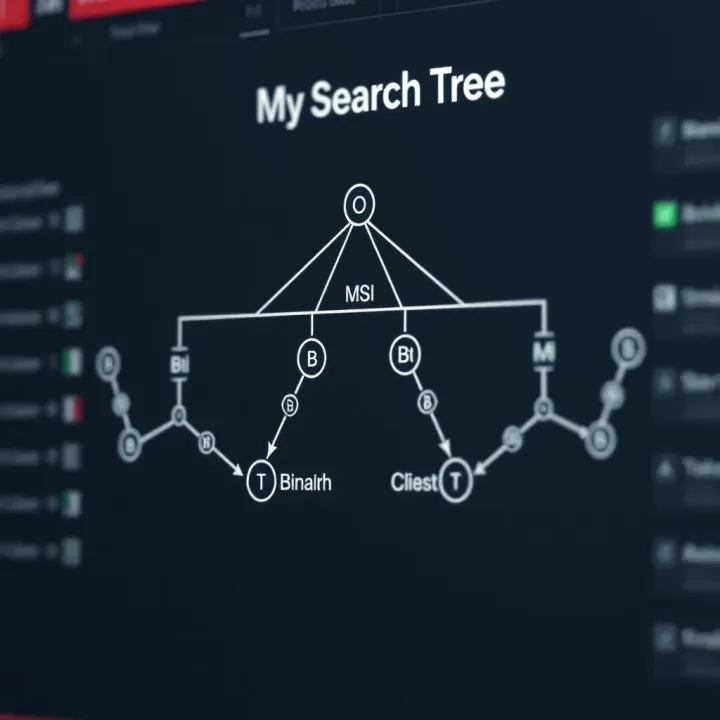
The left subtree of a node contains keys less than the node's key
The right subtree contains keys greater than the node's key
This property allows quicker data access compared to lists or unsorted trees. For example, if you're analysing stock prices sorted by date, a BST lets you locate a particular date's price efficiently without scanning everything.
"BST helps keep data organised so that operations happen quicker, which is especially useful when managing real-time stock or cryptocurrency information."
Ordered Structure: As you navigate from root to leaf, the keys follow a strict ascending order.
Unique Keys: Typically, BST nodes have unique keys; duplicates complicate search and insertion.
Efficient Operations: Searching, insertion, and deletion can be done in O(log n) time on average, better than linear structures.
Consider a crypto trader tracking coin prices over time. Using a BST, the trader can insert new price points as they arrive, quickly find the highest or lowest price within a period, or delete outdated entries without affecting the entire dataset.
In the Indian context, platforms analysing stock or commodity prices often use BST-like structures behind the scenes for speedy data handling.
By grasping BST basics, you improve your skill to work with ordered data, which is vital when you want to make fast decisions based on market trends. The next sections will cover BST's properties, operations, and real-life applications in detail.
Binary Search Tree (BST) is one of the most widely used data structures in computer science, particularly in searching and sorting tasks. It organises data hierarchically, allowing quick access, insertions, and deletions. For anyone involved in software development, database management, or even algo-trading platforms, understanding BST simplifies managing large datasets effectively.
A Binary Search Tree is a special case of a binary tree where each node holds a unique value, and these values are arranged in an ordered way. Specifically, for any node, all values in its left subtree are less than the node’s value, and all values in its right subtree are greater. This property makes BST efficient for search operations compared to a simple list or unsorted binary tree.
Think of it like a telephone directory arranged by names so that you can quickly locate a name without flipping through each page. Similarly, BST helps computers locate data rapidly.
Although both are tree data structures, a binary tree has no specific ordering between nodes. That means you can insert elements in any order without any relation to their values. In contrast, BST enforces a strict ordering rule that left child nodes are smaller and right child nodes are bigger than the parent, as explained earlier.
This ordering helps BST perform faster searches, insertions, and deletions, unlike a general binary tree where these operations may require scanning many nodes. For instance, if you want to retrieve the price of a particular stock quickly, using BST would be far more efficient than a general binary tree.
BST offers a way to organise data so that searches can avoid checking every element. Usually, it reduces the time needed to find data significantly. For example, searching in an unsorted array costs O(n), checking each element, but BST can reduce this to approximately O(log n) in balanced trees.
For stockbrokers analysing large volumes of trade data or investors tracking various portfolios, BST ensures quicker data retrieval. Its sorted structure also simplifies in-order traversal producing sorted outputs directly, saving an extra sorting step.
Beyond algorithms, BSTs find practical uses in database indexing, online transaction processing, and even auto-complete features in software. Word processors use BST for dictionary look-ups. Similarly, trading apps use BST-like structures to organise and rank stock prices or transaction records.
For cryptocurrency analysts, BST helps organise the order book or transactions efficiently, enhancing real-time search and updates. These usages highlight its importance well beyond theoretical computer science, touching everyday tools that traders and investors rely on.
Understanding BST’s basics prepares you to handle large data flows intuitively, especially in finance and trading where time is money, literally.
This introduction sets the stage for exploring BST’s core properties and operations, making it easier for readers to grasp how BST fits within data structures and why it is indispensable in computing and financial sectors.
Understanding the core properties of a Binary Search Tree (BST) is essential when working with data structures for efficient searching and sorting. These properties dictate how nodes are arranged and ensure that operations like insertion, deletion, and search run smoothly and fast.

In a BST, the value of every left child node must be strictly less than its parent node's value. This rule helps maintain the tree's sorted nature and makes searching efficient. For example, if the parent node holds the value 50, then all nodes in its left subtree will have values less than 50, such as 30 or 45. This clear boundary means when you look for a value smaller than the parent, you only explore one direction, speeding up retrieval.
Similarly, all right child nodes must have values greater than their parent node. Taking the same parent node of 50, the right subtree will contain values such as 60 or 75, all greater than 50. This separation prevents confusion about where a particular value lies in the tree. When inserting or searching, the algorithm decides the direction based on comparison, saving time and reducing complexity.
BSTs generally avoid duplicate values to keep the structure simple and unambiguous. Having two nodes with the same value can complicate search operations or require extra rules to handle duplicates. This restriction ensures that each node’s position uniquely represents its value. In real-life applications, like a stock trading system where asset IDs need to be unique, this feature helps maintain clear records and fast lookup without clashes.
One remarkable property of BST is that an inorder traversal (visiting left child, then parent, then right child) prints node values in sorted order. If you traverse a BST in this manner, you get an ascending sequence of values. This is very useful when you need sorted data without applying an explicit sorting algorithm. For instance, when analysing stock prices stored in BSTs, an inorder traversal will immediately give you prices arranged from lowest to highest, facilitating quick insights.
These properties together make BSTs powerful tools for data management where speed and order are necessary, such as in finance or database indexing.
By maintaining proper node arrangements and leveraging BST characteristics, you can ensure your data structure supports fast, reliable operations essential for any trading or analytical platform.
In a Binary Search Tree (BST), the main operations — insertion, searching, and deletion — form the backbone of its functionality. Understanding these operations helps you use BST efficiently, especially for tasks like quick data retrieval, dynamic data management, and maintaining ordered data.
Insertion into a BST starts by comparing the new value with the root node. If the value is less, it moves to the left child; if more, to the right child. This continues recursively until it finds an empty spot where the new node can be placed. For example, if you're adding ₹50,000 to a BST storing investment amounts, and the root has ₹1,00,000, the new node would go to the left.
This method keeps the BST ordered, making sure every insert maintains the property where left children are smaller and right children are larger. This structure speeds up future searches.
BSTs usually do not allow duplicate nodes because it complicates searching and ordering. However, in practical scenarios like tracking repeated transactions, duplicates may arise. One common approach is to keep duplicates on either the left or right consistently. For instance, you might choose to insert duplicates always to the right sub-tree.
Such handling ensures the BST remains predictable. Alternatively, you might store a count alongside nodes, which keeps duplicates compact and easy to track.
Searching in a BST uses the same logic as insertion. Starting at the root, compare the key with the node's value. If it matches, search ends successfully. If the key is smaller, move left; if larger, move right. For example, searching for ₹75,000 in your investments BST will quickly guide you based on comparisons.
This method cuts down unnecessary checks, unlike linear search in arrays. Its directional decision-making accelerates retrieval, making BST practical for large, sorted datasets.
In an ideal case, BST’s height is balanced, making search operations run in O(log n) time, where n is the number of nodes. This means the time to find a node grows slowly even as data increases.
However, if the tree becomes skewed (like a linked list), search time degrades to O(n). Balancing techniques or self-balancing trees like AVL or Red-Black Trees help avoid such situations.
Removing a leaf node (a node with no children) is straightforward. You simply remove the node from the tree and update the parent pointer to null. For example, if an old investment of ₹10,000 is closed and represented as a leaf node, cutting it off keeps the BST clean.
When deleting a node with one child, replace the node with its child. Suppose a node holding ₹20,000 has only a right child of ₹25,000; when deleted, ₹25,000 node takes its place. This preserves BST properties without losing data.
This case is trickier. The node is replaced either by its in-order predecessor (maximum value in left subtree) or in-order successor (minimum value in right subtree). For instance, deleting ₹50,000 node with two children requires finding a suitable replacement to maintain order.
After replacement, recursive deletion ensures no duplicates remain. Though complex, this operation preserves BST’s sorted nature.
Mastering insertion, searching, and deletion in BST can dramatically improve how you manage and retrieve ordered data in stock portfolios or trading applications, providing quick access and flexibility essential in fast-moving markets.
Traversal techniques in a Binary Search Tree (BST) help us visit each node in a specific order. This is crucial because it allows us to retrieve, display, or modify the data stored in the tree in meaningful ways. For traders and financial analysts working with large datasets, understanding these techniques can optimise data handling tasks, like sorted data extraction or hierarchical analysis.
In Inorder traversal, we first visit the left subtree, then the current node, and finally the right subtree. This process is repeated recursively for every node. As a result, the nodes are visited in ascending order of their values, which aligns perfectly with BST properties. For example, if a BST holds stock prices, an inorder traversal will give all prices sorted from lowest to highest.
The reason Inorder traversal produces sorted data lies in BST's definition: every left child is smaller, and every right child is larger than the parent node. By visiting left nodes first and right nodes later, it naturally orders data from the smallest to the largest value. This sorted output proves useful when you need ordered datasets, like generating reports or organising financial indicators.
Unlike Inorder traversal, Preorder and Postorder traverse nodes in a different sequence. Preorder visits the current node first, then the left subtree, followed by the right subtree. Postorder, on the other hand, visits the left subtree, right subtree, and finally the current node. These approaches don’t guarantee sorted output but help with understanding the tree’s structure or performing specific operations.
Preorder traversal is widely used when you want to copy or clone a BST because it processes the parent node before children. This approach is handy when backing up market data hierarchies or replicating structures for analysis. Postorder traversal serves well in deleting trees or nodes, like clearing memory or processing dependency checks after analysing datasets. Both types assist professionals when tree structure matters more than sorted data.
Traversal techniques let you either see data sorted, understand tree structure, or manage memory efficiently—each valuable depending on your financial data needs.
Implementation examples in Hindi help bridge the gap between theory and practice for many learners. When concepts like Binary Search Tree (BST) are taught in English-only, it can be a challenge for Hindi-speaking students and professionals to fully grasp the logic and syntax. Explaining code in Hindi clarifies complex ideas, making BST implementation accessible and practical. For instance, a coding example showing how to insert nodes in a BST while narrating the step-by-step logic in Hindi helps readers internalise the process effectively.
More importantly, such examples provide a hands-on approach to understanding BST operations like insertion, searching, and deletion. Practical illustrations in Hindi also address common doubts simultaneously – for example, why certain conditions are checked or how recursive calls work in the context of BST. This approach can boost confidence when students later write their own programs or optimise existing ones.
Presenting a simple BST example with Hindi explanation helps demystify programming for beginners. It typically starts with defining a node structure, showing how each node contains data and pointers to its left and right children. The Hindi commentary guides you through insertion logic: if the new value is less than the current node, it goes to the left subtree; if more, to the right subtree. This relatable walkthrough saves time spent on struggling with abstract textbook concepts.
For example, while inserting nodes ₹50, ₹30, and ₹70, the Hindi explanations clarify how the tree expands step by step, ensuring the structure remains sorted. This makes the learning curve smoother, especially for non-English speakers working in data structures and algorithms.
One major pitfall is neglecting to handle duplicate values correctly. BSTs typically do not allow duplicates, but beginners might forget to check this and create erroneous trees. Another common mistake is mishandling null pointers during insertion or deletion, which can lead to runtime errors. Hindi explanations often highlight these pitfalls with simple analogies that stick in memory, such as comparing duplicate insertion to trying to add the same book twice on a unique shelf.
Another issue is improper recursion termination conditions. If termination is not clear, the program may enter infinite loops or crash. Explaining these scenarios in Hindi, with clear examples, prevents learners from repeating such errors.
BSTs help speed up searching in databases by organising data in a way that reduces unnecessary comparisons. For instance, consider a database of ₹1 lakh customer records sorted by customer ID. A BST allows searching for any customer in roughly log² (₹1 lakh) tries rather than scanning all records linearly. This reduces time significantly when handling large data, which is crucial for financial systems, stock exchanges, and e-commerce platforms.
In day-to-day applications like digital banking apps, BST-based indexing ensures quick retrieval of information such as transaction history or balance updates. Explaining this use case illustrates practical benefits of BST beyond academic exercises.
BSTs are natural candidates for building sorted data structures needed in many financial and investment tools. For example, a trading app may use BSTs internally to store stock prices or transaction timestamps, maintaining sorted order for quick lookups and updates.
This facilitates functions like displaying the top gainers and losers in the stock market or tracking price changes efficiently over time. BSTs support dynamic data where insertions and deletions happen frequently, unlike static arrays that require costly re-sorting. Hindi explanations of these uses show how theoretical data structures apply to everyday software used by traders and analysts.
A well-understood BST implementation can be the backbone for fast, efficient financial data handling systems in India’s rapidly growing digital economy.
Through Hindi examples and real-world connections, learners can appreciate the practical significance of BST and confidently implement it in their projects or prepare for competitive programming and interviews.
Learn how to implement a Binary Search Tree (BST) program with clear steps on insertion, traversal, and deletion 🌳. Understand BST properties for efficient data handling.

Learn to implement binary search in C using arrays with clear steps, optimisation tips, and common pitfalls ⚙️. Ideal for Indian programmers seeking efficient search methods.

🔍 Learn binary search, a fast way to find items in sorted lists by halving search space each time. Get stepwise guidance, practical tips, common mistakes, and speed optimisations.

Learn how to build an optimal binary search tree step-by-step 🌳 using dynamic programming. Minimize search cost with clear examples and key concepts explained 🔍📊.
Based on 8 reviews