

How to Use a Binary Multiplication Calculator
Learn how to multiply binary numbers easily with a binary multiplication calculator 🧮. Understand key algorithms, practical uses, and tips for accurate computing 🇮🇳.
Edited By
Henry Walker
Binary operations form the backbone of digital computing, influencing everything from stock market data processing to cryptocurrency algorithms. Understanding binary arithmetic is essential for traders and financial analysts who rely on technology-driven tools for accurate decision-making. A binary operations calculator simplifies these calculations by quickly processing binary numbers, reducing the chance of human error and saving valuable time.
A binary number system uses only two digits, 0 and 1, representing the off and on states in digital electronics. For instance, the decimal number 13 converts to binary as 1101, which stockbrokers might encounter while dealing with low-level communication between trading programs and hardware nodes.

Common binary operations include AND, OR, XOR, NOT, addition, and subtraction. Manually carrying out these operations on long binary strings can be tedious and prone to mistakes—particularly when analysing trade signals or processing market data streams.
Using a binary operations calculator helps professionals focus more on strategy and less on manual conversions. It ensures faster, more reliable computation for complex binary tasks.
To use these calculators effectively, it's important to understand how binary logic works:
AND operation: Results in 1 only if both bits are 1; widely used in masking bits during data filtering.
OR operation: Results in 1 if at least one bit is 1; often applied in setting flags or permissions.
XOR operation: Returns 1 if bits are different; useful for error detection algorithms in financial transmissions.
Besides logical calculations, binary addition and subtraction are crucial when programming financial models or running simulations. For example, adding 1011 (binary for 11) and 0101 (binary for 5) yields 10000 (binary for 16), a basic yet essential step in automating trading computations.
Professionals who take the time to master both manual methods and calculator tools gain confidence in interpreting and troubleshooting digital outputs. This skill becomes particularly useful when analysing raw market feeds or optimising custom algorithmic trading strategies.
In the next sections, we will explore how these calculators function under the hood, their practical applications in finance and trading, and step-by-step guides for common manual calculations.
Binary operations form the backbone of digital technology, enabling computers and many electronic devices to perform calculations and process data. Understanding these operations is vital if you want to grasp how systems work behind the scenes, especially if you deal with programming, digital electronics, or finance technologies like blockchain. With a solid grasp of binary operations, you can appreciate the simple yet powerful rules that help machines execute complex tasks quickly and accurately.
The binary number system uses just two digits: 0 and 1. Unlike the decimal system, which operates on base 10, binary works on base 2. Each digit in a binary number represents a power of 2, starting from the rightmost digit (least significant bit). For instance, binary 1011 stands for (1×2³) + (0×2²) + (1×2¹) + (1×2⁰) = 8 + 0 + 2 + 1 = 11 in decimal. This binary method is practical because digital circuits only recognise two states — on or off — simplifying hardware design.
Binary and decimal differ mainly in the number of symbols they use and their place values. While decimal uses ten symbols (0–9), binary uses only two (0 and 1). Each position in a decimal number is a power of 10, whereas in binary, it’s a power of 2. This difference affects how numbers are stored and manipulated digitally. For example, the decimal number 25 is 11001 in binary. Trading algorithms rely on binary calculations processed fast by hardware, where decimal doesn’t directly translate to the chip’s language.
Binary digits, or bits, are the smallest data units in computing. A series of bits, called a byte (8 bits), is the basic data chunk used in computers. Each bit can be set to 0 or 1, representing off or on. In networking, IP addresses are often represented in binary to determine subnets and network masks. For example, the IPv4 address 192.168.1.1 is 11000000.10101000.00000001.00000001 in binary. Understanding this helps professionals debug network problems or configure routers for optimal performance.
Adding and subtracting in binary follow simple rules similar to decimal but adapted for base 2. In addition, 0 + 0 equals 0, 1 + 0 equals 1, and 1 + 1 equals 10 (which means 0 carry 1). For instance, adding binary 101 and 110 results in 1011. Subtraction uses borrowing, where 1 is borrowed when subtracting a larger bit from a smaller bit. These operations are essential for low-level programming, cryptography, or any task requiring precise control over bitwise data.
Binary multiplication is essentially repeated addition, simplified since the digits are only 0 or 1. Multiplying by 1 retains the number; multiplying by 0 gives 0. For example, 101 x 11 equals 1111 in binary. Division is more complex but follows the long division method adapted for binary digits. Mastery of these operations can assist traders and analysts working with systems processing large binary datasets or machine-level programming.
Logical operations manipulate bits according to boolean rules. AND returns 1 only if both bits are 1; OR returns 1 if either bit is 1; XOR (exclusive OR) returns 1 if bits differ; NOT inverts bits. These are fundamental in programming for setting, clearing, or toggling bits — crucial when working with permissions, flags, or cryptographic algorithms in financial software. For instance, using XOR helps in error detection and simple encryption suitable for secure transactions.
Understanding these core binary concepts and operations builds a strong foundation to use a binary operations calculator effectively and interpret its results confidently. This knowledge matters not just in programming or electronics but also in fields like financial modelling, where binary logic underpins data security and algorithmic trading.
Binary numbers use base 2, with only two symbols: 0 and 1.
Binary operations reflect how computers process and store data.
Logical operations help in programming and secure financial systems.
Mastering binary fundamentals is the first step towards leveraging calculators and tools designed to simplify these calculations in practical scenarios.
Understanding how a binary operations calculator works is essential for traders, investors, and analysts dealing with complex computing tasks or blockchain technologies. This calculator simplifies binary arithmetic by handling input, processing calculations, and displaying results swiftly and accurately. Knowing the underlying mechanisms helps users trust the results and use the tool efficiently, especially when working with bitwise data in financial algorithms or cryptographic applications.
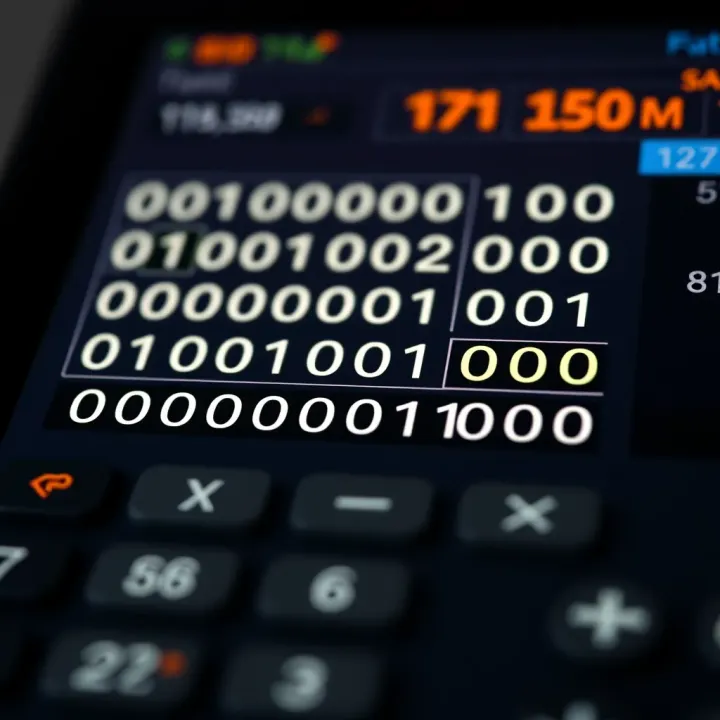
Entering binary numbers: The user interface typically provides a straightforward way to input binary numbers, often via clickable buttons for digits '0' and '1' or a keyboard interface for faster entry. This ensures accuracy since even a small mistake in binary input can lead to vastly different results. For instance, entering 1010 instead of 1001 changes the decimal value from 10 to 9, which can seriously affect calculations in cryptographic key generation or trading algorithms.
Selecting the type of operation: Binary calculators allow users to choose from arithmetic operations like addition, subtraction, multiplication, and division, along with logical operations such as AND, OR, XOR, and NOT. Selecting the correct operation is vital for getting meaningful outcomes. Traders working on automated strategies might use bitwise AND to filter specific flags within data streams, so a clear operation selection avoids errors.
Additional functions like conversion to decimal or hexadecimal: Since many professionals prefer to view results in decimal or hexadecimal, calculators often include conversion tools. These functions help cross-verify binary outputs or prepare data for systems that don’t support binary directly. For example, a financial analyst interpreting blockchain transaction IDs might convert binary to hexadecimal for easier readability or for integration with analysis tools.
Algorithm behind binary arithmetic: The calculator applies algorithms matching the chosen operation, such as performing bit-by-bit addition with carrying for binary addition. This process eliminates manual effort and reduces mistakes common in complex binary calculations. For example, a bitwise XOR operation on two binary stock flags can be swiftly processed using a simple algorithm behind the scenes.
Error checking and validation: To ensure correct results, calculators include error checking features that validate inputs and operations. They catch invalid binary characters or mismatched input lengths before processing. This is particularly useful for financial analysts who might deal with long binary sequences, ensuring they do not waste time on errors that skew results.
Presenting results in multiple formats: After computation, results often appear in binary, decimal, and hexadecimal formats, catering to diverse user needs. Showing results in multiple formats helps traders or developers cross-check and share outputs easily across platforms. For instance, displaying subnet mask calculations in both binary and decimal proves handy when configuring network settings for secure trading environments.
A binary operations calculator not only streamlines calculations but also minimises manual errors, making it an indispensable tool for anyone dealing with binary data in finance and technology.
The ease of input, selection of operations, robust processing, and versatile output presentation collectively make these calculators practical and reliable for professional use.
Manual binary calculations remain important even in the age of digital tools. Traders, investors, and financial analysts who deal with low-level data processes or cryptography can benefit from understanding how these calculations work behind the scenes. Performing binary arithmetic manually sharpens problem-solving skills, helps verify calculator outputs, and provides insight into data manipulation at the bit level.
Binary addition follows simple carry rules similar to decimal addition but with only two digits, 0 and 1. When adding two 1s, the sum is 0 with a carryover of 1 to the next higher bit. For example, 1 + 1 = 10 in binary, where 0 is placed and 1 is carried forward. This process continues across the length of the binary numbers. Similarly, subtraction involves borrowing when the top bit is smaller than the bottom bit. Borrowing from the next significant bit changes that bit from 1 to 0 and adds 2 to the current bit.
Understanding these rules is crucial for accuracy in manual calculations, especially when debugging software or reviewing financial algorithms where binary data impacts outcomes.
Consider adding binary numbers 1011 (decimal 11) and 1101 (decimal 13). Adding bit-wise from right to left:
1 + 1 = 0 (carry 1)
1 + 1 + 1 (carry) = 1 (carry 1)
0 + 1 + 1 (carry) = 0 (carry 1)
1 + 1 (carry) = 0 (carry 1)
Result becomes 11000 (decimal 24).
Similarly, for subtraction, 1101 (13) minus 1010 (10) involves borrowing where needed. This step-by-step approach clarifies how binary operations work at the bit level, useful when tracing logical errors.
Manual binary multiplication closely mirrors decimal multiplication but uses bit shifts and additions. Multiply each digit of the bottom number by the entire top number, shifting left every time you move to the next higher bit. For instance, multiplying 101 (5 decimal) by 11 (3 decimal):
Multiply 101 by 1 (rightmost bit) → 101
Multiply 101 by 1 (next bit), shift left by one → 1010
Add both results: 101 + 1010 = 1111 (decimal 15).
This method teaches the interplay of addition and shifting, an important concept in low-level financial software and algorithmic trading where bitwise operations affect performance.
Binary division uses repeated subtraction and shifting. Consider dividing 1101 (decimal 13) by 10 (decimal 2). Subtract the divisor from the most significant bits of the dividend, shifting the result left as you go. Each successful subtraction adds a bit to the quotient.
For example:
11 (3 decimal) is larger than 10 (2 decimal), so subtract and place 1 in quotient's current bit.
Bring down the next bit and repeat until all bits are processed.
The quotient is 110 (6 decimal), and remainder 1.
Learning manual binary division supports better comprehension of processes behind algorithms used in finance and cryptography, enhancing trust in automated calculations.
Understanding manual binary calculations gives you an edge to verify software outputs and improve your grasp of data manipulation at the foundational level, a valuable skill in trading and financial data analysis.
Binary operations calculators serve as vital tools beyond simple arithmetic—they bridge the gap between theory and real-world applications, especially in tech-driven fields. Their practical use ensures greater precision and faster handling of binary data, which is central to computing and digital design.
Debugging and testing code involving binary data demand accurate manipulation of binary numbers. Programmers often face scenarios where data is stored or transmitted in binary form. A binary operations calculator helps verify outputs quickly—whether it's checking the parity bits of a data packet or ensuring correct flag settings. Without such tools, debugging bit-level errors can be tedious and error-prone.
For example, consider a programmer working on a compression algorithm writing binary sequences directly to a file. Testing subtle bit manipulations manually is impractical; a calculator can swiftly confirm if operations like bit shifts or masks yield the intended binary pattern.
In programming, working with bitwise operators is routine when optimizing code or interfacing with hardware. Bitwise AND, OR, XOR, and shifts impact efficiency directly by enabling operations at the bit level. Using a binary calculator aids in understanding how these operators modify bits.
For instance, to mask out certain bits from an integer or toggle flags in control registers, programmers can input values and test bitwise combinations on the calculator. This reduces guesswork and accelerates development, especially when dealing with complex bit patterns in languages like C or embedded assembly.
Calculating IP addresses and subnet masks in networking requires binary arithmetic to divide networks efficiently. A common example is converting subnet masks from decimal to binary form and performing AND operations to determine network addresses.
Network engineers working with IPv4 addresses use binary operations calculators to avoid manual errors when defining subnets, particularly in large corporate networks. For example, computing the exact range of IP addresses in a subnet can be done easily by applying binary AND between IP and subnet mask, which the calculator simplifies.
In designing digital circuits, binary calculators help engineers deal with logic gates and their combinations. Constructing circuits with AND, OR, NOT, NAND, NOR gates requires understanding input-output relationships at the bit level.
When designing a 4-bit binary adder or flip-flop circuits, the calculator makes it easier to verify truth tables or simulate boolean expressions. Quick checks of output signals based on input combinations help ensure the circuit functions correctly before actual hardware implementation.
To sum up, binary operations calculators are more than number crunchers—they're invaluable aids in programming, networking, and electronics, offering accuracy and speed that manual methods struggle to match.
Selecting the right binary operations calculator can save time and reduce errors, especially for professionals handling large data sets or working on complex programming tasks. An effective calculator not only performs multiple binary functions but also offers clear outputs and error handling, ensuring you make accurate decisions based on the results.
A calculator should handle a range of binary operations like addition, subtraction, multiplication, and division along with bitwise logical functions such as AND, OR, XOR, and NOT. For example, a trader analysing algorithmic trading models might need to compute bitwise operations to debug logic embedded in trading software. Having all these operations in one tool eliminates the need to switch between different calculators, streamlining your workflow.
Ease of use matters a lot. A clutter-free interface with intuitive button layout or dropdowns reduces input mistakes and speeds up calculations. Some advanced calculators offer visual aids, such as colour-coded bits or stepwise operation displays, to clarify how results are derived. In financial analysis where accuracy is critical, a clear interface prevents costly errors compared with manually calculating or using clunky tools.
Binary data often connects with decimal, hexadecimal, or octal systems. Calculators with built-in conversion features let you toggle between these systems effortlessly. This is handy for investors analysing low-level data representations or programmers testing code outputs. Additionally, options to display results in various formats—like signed, unsigned binaries, or two’s complement—add flexibility depending on your use case.
Binary inputs can be long and error-prone. Double-checking each bit entered is cumbersome but vital. Some calculators provide input validation by alerting you if non-binary digits are entered or the input length exceeds practical limits. Using these safeguards helps avoid miscalculations that would skew financial models or coding logic.
Understanding how the calculator handles signed numbers, overflow, or negative results is essential. A misinterpretation could lead to wrong conclusions, such as miscalculating portfolio risks or digital circuit behaviour. Always verify the number format selected aligns with the problem, whether it’s unsigned binary or two’s complement.
Multiple Indian tech platforms offer reliable binary calculators integrated with other financial or coding tools. Using such localised tools may provide better support for regional users, including language preferences and customer care. Besides, some government portals and educational websites incorporate calculators optimised for syllabi and exams common across India, which is a bonus for students and analysts training themselves.
Choosing the right binary calculator equipped with diverse operations, clear interfaces, and smart features can really enhance accuracy and save time, making it an indispensable part for anyone dealing with binary data regularly.
This practical approach ensures you pick a calculator fit for your needs, whether in trading, investing, programming, or education.
Learn how to multiply binary numbers easily with a binary multiplication calculator 🧮. Understand key algorithms, practical uses, and tips for accurate computing 🇮🇳.

Learn how to convert binary numbers to octal easily 🔢 with a step-by-step guide. Discover practical uses & top online converters for computing and electronics efficiency.
🔢 Learn how octal and binary systems work & convert octal to binary easily with a calculator. Get tips, tricks, and practical uses for computing & electronics! ⚙️

Explore online binary calculators 🖥️ to perform conversions, arithmetic, and digital system tasks with ease. A practical guide for learners and pros alike!
Based on 6 reviews