

Key Operations on Binary Search Trees Explained
Explore detailed operations on Binary Search Trees 🌳 including insertion, deletion, searching, and traversal + tips on balancing & handling common challenges efficiently.
Edited By
Isabella Morgan
Breadth-first search (BFS) is a method used to traverse or search through data structures like binary trees. For traders and analysts dealing with algorithmic trading, or investors learning data structures behind fintech tools, grasping BFS helps in understanding how software efficiently explores information in layers.
BFS works by exploring all nodes at one level of a tree before moving on to the next. Imagine scanning company hierarchies or decision trees in stock markets: BFS checks all options on the same rung first, ensuring a level-wise view.

In a binary tree, each node has at most two children, commonly called left and right. BFS visits nodes level by level, starting from the root node, then its children, then grandchildren, and so forth. This contrasts with methods like depth-first search (DFS), where exploration goes deep down one branch before backtracking.
Understanding BFS is useful in applications such as:
Portfolio optimisations where decision trees represent various investment paths.
Search algorithms used in financial software to find specific values or conditions.
Natural language processing models analysing market sentiment through tree structures.
BFS ensures a thorough, systematic approach to exploring binary trees that can mirror financial decision-making layers.
A practical example: Say you’re analysing a binary tree representing sector investments, with each node showing potential returns. BFS examines options by sectors first (level-wise), which is ideal when evaluating broad market moves before narrowing down to individual stocks.
The order and systematic traversal of BFS make it straightforward to implement and understand, particularly with the help of a queue data structure. This aligns well with the logic many trading algorithms embed to process data efficiently.
Having a clear idea of BFS builds a strong foundation to explore more complex algorithms used in financial applications and software development. Next, we will look into how the algorithm actually runs step by step and compare it with other traversals useful in various contexts.
Breadth-First Search (BFS) is a fundamental tree traversal method widely used in computer science, including areas like financial data analysis and decision-making algorithms. BFS explores nodes level by level, making it especially useful when insights at each hierarchical layer matter, such as assessing risk categories in investment portfolios or analysing layered network data.
Understanding BFS helps you handle binary trees effectively, a crucial data structure in representing structured information. Its systematic approach gives you a clear picture of the tree’s breadth before descending deeper, essential when comparing investment strategies or modelling financial market scenarios.
Breadth-First Search is a traversal technique for trees or graphs where nodes are visited level-wise, starting from the root and moving down to the next level only after all nodes at the current level are covered. Imagine scanning a company’s organisational chart from the topmost level to the more junior ranks systematically — that’s BFS in action.
Practically, BFS uses a queue to remember nodes to visit next, ensuring no node at a given level is missed before moving deeper. This feature makes BFS practical for applications like calculating the shortest path between investments or understanding network reach.
Depth-First Search (DFS) dives deep into one branch before backtracking, much like following a lead from a single stock’s impact down through its various market influences. BFS, on the other hand, covers all possibilities at one level before proceeding.
While DFS requires less memory, BFS shines when the problem demands level-based exploration — like evaluating hierarchical liquidity risk or branching scenarios in portfolio diversification where knowing the 'layers' matters for tactical decisions.
A binary tree is a hierarchical data structure where each node has up to two children: left and right. This simplicity allows efficient searching and sorting, enabling algorithms to work with large datasets like historical price records or stock indices quickly.
Binary trees have properties such as height, depth, and balance, which impact traversal efficiency. For instance, a balanced tree ensures BFS covers nodes evenly, reducing the time it takes to examine each level—useful when dealing with balanced asset allocation structures.
Various binary trees can influence BFS performance. A complete binary tree fills all levels except possibly the last, guaranteeing minimal height, which suits BFS well by limiting traversal steps.
On the other hand, a skewed binary tree that leans entirely left or right resembles linked lists and can degrade BFS’s efficiency by increasing depth. Recognising these types helps tailor BFS applications in finance, like in decision trees for derivative pricing or credit risk modelling.
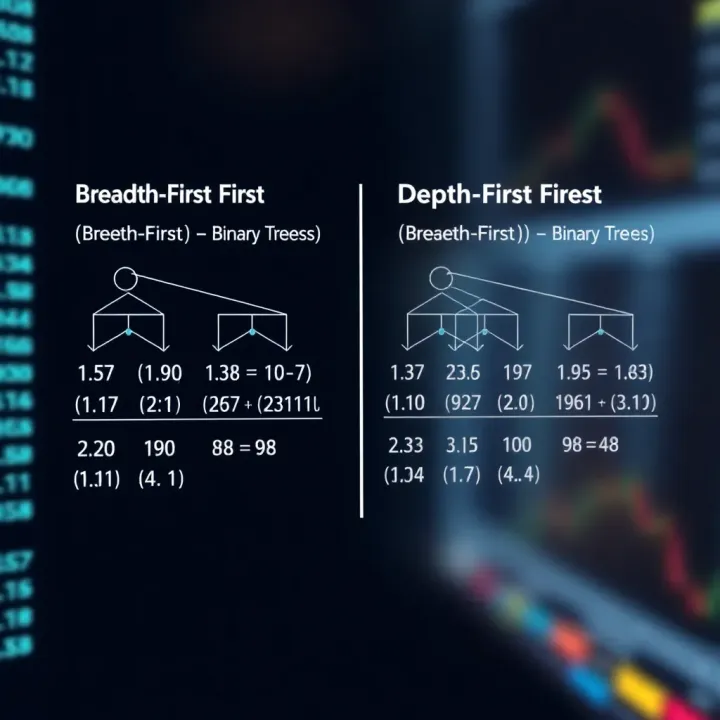
Exploring these aspects of BFS and binary trees equips you with better tools to process complex data structures, a skill valuable for investors and analysts working with hierarchical financial models or large datasets.
Understanding the step-by-step process of breadth-first search (BFS) traversal is fundamental to grasp how the algorithm systematically explores a binary tree. This approach ensures nodes are visited level by level, which comes handy when analysing hierarchical data or simulating processes where order of exploration matters. For investors and financial analysts, visualising data in layers—such as decision trees or market breadth structures—can simplify complex evaluations.
BFS relies on a queue to keep track of nodes to visit next. Initialising this queue involves adding the root node of the binary tree first. This setup lets BFS start from the top (the root) and proceed level-wise downwards. Practically, this means for a financial model based on hierarchical decisions, you begin assessment from the highest level and progress methodically.
Once the queue has the root, the algorithm processes nodes one by one from the front of the queue. Visiting nodes level-wise ensures that all nodes at one depth are explored before moving to the next. This approach is especially useful in cases such as market segmentation trees, where understanding all players at a particular tier before proceeding deeper is beneficial.
For every node dequeued, BFS checks for its children nodes. If children exist, they are enqueued, ensuring they will be visited in subsequent iterations. This step is crucial to maintain level order traversal. Think of this as assessing sub-options only after fully exploring the current set—like evaluating investment instruments within a sector only after understanding the sector itself.
Consider a binary tree representing a decision hierarchy: a root node representing an overall market strategy, two child nodes as sector strategies, and further nodes as individual stock picks. This structure helps clarify how BFS examines decisions systematically, providing a clear path from general to specific.
Starting from the root node (market strategy), BFS adds its children (sector strategies) to the queue. It visits each sector node in turn, then adds their children (stock picks) to the queue. This pattern continues until all levels are explored, ensuring no node is skipped. In practical terms, this method allows a thorough yet organised inspection of options—a must for methodical financial analysis.
Using BFS level-wise traversal helps maintain clarity and order in complex analyses, making it easier to track progress and identify gaps.
This methodical approach, while straightforward, offers a powerful way to explore binary trees and related hierarchical data efficiently.
Putting Breadth-First Search (BFS) into code is essential for anyone looking to apply this traversal in real-world problems. It brings the abstract concept to practical use, ensuring that binary trees can be processed level by level efficiently. Whether working on search algorithms, network analysis, or hierarchical data processing, implementing BFS gives you the framework to traverse nodes systematically.
The logical flow of BFS hinges on visiting nodes in a breadth-wise manner, typically moving level by level starting from the root. The core process involves using a queue to keep track of nodes to visit next. Initially, the root node is placed in the queue. Then, in each iteration, the algorithm dequeues a node, processes it, and enqueues its left and right children if they exist. This loop continues until the queue is empty, signalling that all nodes have been visited.
This structured approach ensures that nodes closer to the root are visited before those further down, which is practical for tasks like finding the shortest path in a tree structure or visualising levels distinctly.
Key operations revolve around managing the queue correctly. First, initialising it with the root prevents missing the starting point. Then, the algorithm must carefully handle empty queues to avoid errors. Checking for null children before enqueueing is crucial to prevent unnecessary processing or errors. Overall, these conditions sustain the correctness and efficiency of BFS, especially in large or unbalanced binary trees.
BFS implementation in Python is straightforward thanks to built-in data structures. Using Python’s collections.deque for the queue empowers efficient insertion and deletion from both ends, suiting BFS perfectly. The code is usually succinct, making it suitable for learners and developers who want quick prototyping. Python’s readability helps in debugging and adapting BFS for various applications.
Java, being widely used in enterprise environments, offers robust queue implementations like LinkedList which can be directly used for BFS. Java’s static typing provides additional safety by catching errors during compilation. Writing BFS in Java is beneficial when integrating the traversal into larger software systems that require maintainability and performance. The syntax might be more verbose than Python but gives you fine-grained control over memory and execution.
Implementing BFS in popular languages like Python and Java not only aids understanding but also prepares you for practical challenges in tech roles, from coding interviews to development tasks.
By seeing how the algorithm unfolds in code, you grasp nuances like queue management and conditional checks, which mechanical explanations often miss. This grounding supports confident use of BFS in diverse scenarios, be it algorithm competitions or software projects.
Breadth-First Search (BFS) offers specific strengths and weaknesses when applied to binary trees. Understanding these helps traders, investors, and analysts decide when to employ BFS in algorithmic or data analysis tasks related to hierarchical datasets or graph-like structures.
BFS works well for problems where exploring nodes level by level benefits the solution. For example, in hierarchical stock market data queries, BFS effectively retrieves all companies at a particular market capitalization tier before moving to the next. This level-wise exploration suits cases needing grouped data insights or breadth-based scanning.
BFS also excels in finding the shortest path between nodes in unweighted binary trees. Consider analysing supply chain networks for commodities; BFS can quickly pinpoint the minimal number of steps from source to destination entities. This characteristic proves valuable when speed and accuracy in navigation through connected data points matter.
One major drawback of BFS arises from its memory requirement. Because it stores all nodes at the current level in a queue, the algorithm demands significant memory when dealing with wide or dense binary trees. For instance, analysing complex financial portfolios with deeply nested assets might exceed available memory, slowing down or halting processing.
Handling very large binary trees poses practical challenges too. Since BFS explores every level fully before progressing, traversal time can grow quickly with tree size. In market analysis involving millions of data points, this may result in longer wait times. Optimisations or alternative approaches, like pruning irrelevant branches early, are often necessary to maintain efficiency.
BFS is powerful for level-wise insights and shortest path problems but requires careful application to prevent memory overload or excessive processing delays, especially in large datasets.
To balance BFS’s benefits against limitations, consider tree size, required depth of search, and resource availability. Applying BFS selectively can avoid performance pitfalls while harnessing its advantages for structured data exploration.
Suitable for level order data retrieval and shortest path in unweighted trees
High memory usage when tree breadth expands rapidly
Slow traversal times on very large or deep trees without optimisation
Breadth-First Search (BFS) plays an essential role beyond just theoretical algorithms; its applications in real-world scenarios highlight its usefulness, especially where understanding or processing hierarchical or multi-level structures is required. This section explores how BFS aids in computer science tasks and software development, giving readers practical insights into its value.
Level order traversal, a direct outcome of BFS on binary trees, is often used to present data in a structured, level-wise manner. For instance, visualising a company's organisational chart or the structure of hierarchical data like a family tree benefits from BFS traversal. It helps users see the elements at each depth clearly instead of jumping randomly across levels. This approach is useful in debugging tree structures or when UI components need to display layered information sequentially.
In puzzles or game development, BFS finds the shortest path or minimum steps needed to reach a goal. A common example is solving the 'Knight's shortest path' problem on a chessboard or finding the quickest way out of a maze. BFS explores all positions reachable in a certain number of moves before moving deeper, ensuring the first time a solution appears, it's the shortest. This property makes BFS invaluable in AI and pathfinding algorithms used in gaming.
Web crawlers use BFS to systematically explore web pages by level to ensure wide coverage without getting stuck in deep but narrow sections of the web. Starting from a main page, BFS helps the crawler check all linked pages first before moving further, which balances speed and comprehensiveness. Similarly, broadcaster systems in peer-to-peer networks or social media use BFS to propagate messages level-wise through nodes, ensuring the message reaches all intended recipients efficiently without excessive resource overload.
Managing hierarchical data like file systems, XML or JSON structures, and organisational databases requires efficient traversal to access or modify nodes. BFS allows programmers to examine or update each level completely before moving on, making it easier to perform level-specific operations such as permission checks, data aggregation, or summaries. This level-wise control simplifies maintenance tasks and enhances performance when dealing with large datasets.
BFS's ability to process data level by level helps create clear, manageable workflows for multiple practical uses, making it a go-to method in both computer science and software engineering contexts.
Understanding these applications helps appreciate BFS as more than an academic concept—it’s a versatile tool for solving real problems across numerous fields.
Explore detailed operations on Binary Search Trees 🌳 including insertion, deletion, searching, and traversal + tips on balancing & handling common challenges efficiently.

Explore how optimal binary search trees 🔍 reduce search costs using dynamic programming. Learn their structure, algorithms, and practical computer science uses.

Explore the structure and varieties of binary trees 🌳 in data structures. Learn traversal methods, operations, and when to choose them over other tree types for better performance.

Explore how to build an optimal binary search tree 🏗️ using probabilities and dynamic programming. Learn to minimize search cost with practical steps! 🔍
Based on 6 reviews