
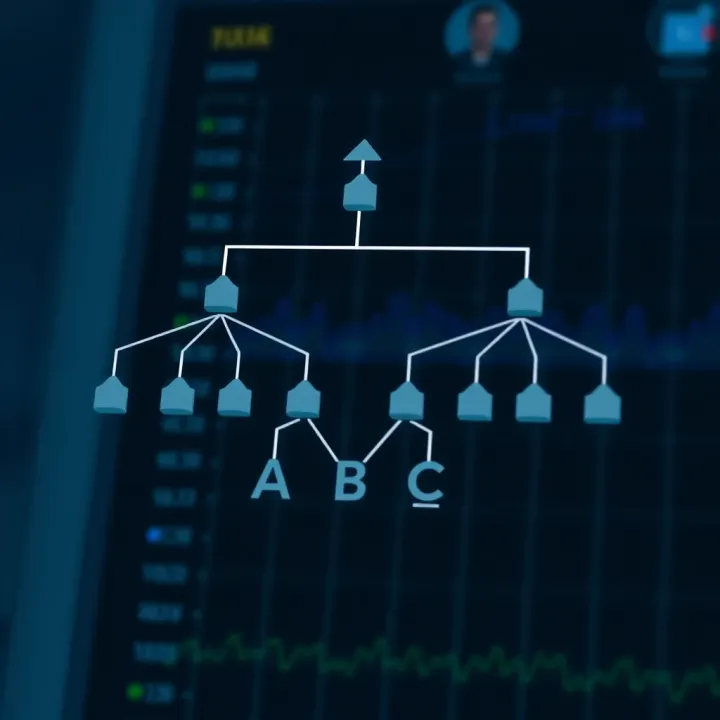
Level Order Traversal Explained for Binary Trees
Explore level order traversal in binary trees 🌳: learn how to visit nodes level by level, with clear examples, implementation tips, and practical uses.
Edited By
Sophia Patel
Binary tree traversal is a key concept in computer science that helps you explore or process every node in a binary tree. You might wonder why this matters for trading or financial analysis — well, binary trees underpin various algorithms, including those used in decision-making, data searching, and organising complex datasets.
Traversal methods define the order in which nodes are visited. The three main types are inorder, preorder, and postorder, each with specific use cases and behaviours.

Inorder traversal visits the left subtree first, then the node itself, and finally the right subtree. This order is especially useful if you want to retrieve data stored in binary search trees (BST) in ascending order. For example, in market data storage, inorder traversal helps fetch stock prices sorted by time or value efficiently.
Preorder traversal processes the current node before its subtrees. This approach works well for copying trees or evaluating expression trees, where the operation at each node is significant before moving to operands. Traders could liken this to making high-level decisions first before drilling down into detailed data.
Postorder traversal visits subtrees first and the node last. It is handy in scenarios such as deleting a tree or evaluating dependencies, which might resemble processes in analysing cascading financial transactions.
Each traversal can be implemented recursively or iteratively. Recursive methods are straightforward but may lead to stack overflow with very large trees, whereas iterative approaches use explicit stacks to avoid this, which can perform better in resource-constrained environments.
Understanding how these traversal methods work helps you grasp the fundamental ways algorithms process hierarchical data structures — important knowledge for coding trading bots, optimising searches, or managing large financial datasets.
Next, we'll explore each traversal method with code samples and practical applications relevant to your trading and analytical needs.
Understanding the basics of binary tree structure is essential for grasping traversal methods clearly. A binary tree organises data in a way that allows easy access and modification, serving as the backbone for many algorithms found in trading platforms, financial analysis tools, and cryptocurrency wallets.
A binary tree consists of nodes, where each node holds a value and pointers to at most two children—commonly referred to as the left and right child. These nodes work together to form a hierarchical data model, making it simple to represent parent-child relationships. For example, in a stock market prediction model, nodes might represent decision points, with child nodes denoting possible outcomes.
Each node typically contains three parts: the data itself, a reference to the left child, and another to the right child. This structure allows for rapid searching and sorting operations which are crucial when dealing with large volumes of market data. If a node has no children, it is called a leaf node.
Binary trees come in several types, each suited to specific tasks. A full binary tree is one where each node has either zero or two children; this often simplifies recursive operations like traversals. A complete binary tree fills each level fully from left to right except possibly the last, ensuring balanced depth—something valuable in maintaining efficient access times. On the other hand, skewed binary trees, where nodes have only one child, are less efficient but may appear naturally in certain datasets.
Traversing a binary tree means visiting all its nodes systematically. This process is necessary to read, modify or analyse data stored within the tree. It’s like scanning through a directory where files are sorted hierarchically; traversal determines the order you access each file.
In trading algorithms, traversal helps evaluate multiple scenarios or calculations stored as tree nodes. For instance, inorder traversal processes nodes in a sorted manner, beneficial when pulling ordered stock prices. Preorder and postorder traversal help in generating sequences based on decision trees or expression trees, such as computing technical indicators.
Traversals find uses beyond data access—they play a role in parsing mathematical expressions, compiling code, and searching for information efficiently. For example, a cryptocurrency wallet might use traversal to verify a transaction’s signatures stored in a Merkle tree structure. In all these cases, understanding the traversal method directly impacts performance and reliability.
Traversal strategies form the foundation for optimised data handling in financial systems, enabling swift insights and reliable operations across massive, tree-structured datasets.
Binary tree traversal methods are essential in understanding how to systematically visit each node in a tree structure. These methods—inorder, preorder, and postorder traversal—provide different sequences for visiting nodes, each suited to specific tasks in programming and data analysis. For traders, investors and financial analysts working with complex data hierarchies or algorithmic decision trees, knowing these traversals helps decode or reorganise data efficiently.
Inorder traversal visits nodes by first exploring the left subtree, then the current node, followed by the right subtree. This method results in visiting nodes in ascending order if the binary tree is a binary search tree (BST). For example, if you store stock prices in a BST by date, applying inorder traversal would list prices chronologically.
Inorder traversal shines in scenarios needing sorted output without additional sorting overhead. It’s widely used in databases and trading algorithms when processing ordered data like historical price points, where the node’s position encodes time or value. This traversal helps efficiently generate reports showing data in a logical sequence.

Preorder traversal visits the current node first, then the left subtree, and finally the right subtree. This means the root node gets processed before its children, useful in copying or storing a tree’s structure since you fetch the parent nodes before their descendants.
Preorder traversal often finds use when recreating tree structures, such as reversing trade decision trees or reconstructing market sentiment flows. For instance, financial models that simulate stepwise decision paths from a root decision can use preorder order to track each stage clearly.
Postorder traversal visits left and right subtrees before the current node. This approach processes all children before the parent, which suits tasks requiring bottom-up evaluation.
In finance, postorder traversal supports evaluation of expression trees used in portfolio value calculations, where you compute component values before aggregating them at the root. It’s also critical in garbage collection algorithms in programming environments, relevant to fintech platforms processing many ephemeral data nodes.
Understanding these traversal methods offers practical tools to manipulate and analyse tree-based data, improving algorithm efficiency and decision-making clarity in financial and trading systems.
This section laid the groundwork to appreciate how specific traversal orders adapt to real-world tasks in markets and computational finance.
Binary tree traversal often benefits from two fundamental approaches: recursion and iteration. Each method offers practical advantages, depending on the problem size and context. Traders, investors, or analysts dealing with algorithmic data processing can choose between these techniques based on efficiency and resource constraints.
Recursion simplifies tree traversal by letting a function call itself to process nodes, which mirrors the natural hierarchical tree structure. This approach avoids manual stack management since the programming language runtime handles the traversal state automatically. For example, a recursive inorder traversal visits the left subtree, the current node, and then the right subtree in an elegant, concise manner. This makes recursive solutions easy to read and maintain, especially when handling complex trees or when embedded in algorithms parsing financial data, like syntax trees for decision-making.
Recursive code typically follows a straightforward pattern: if the current node is null, return; else, recursively visit the left child, process the current node, and then visit the right child. Though simple, this approach can lead to stack overflow for very deep trees if not handled properly. Still, for most practical datasets like market trends or investment scenarios, recursion works well by offering clarity and a direct representation of the traversal logic.
Iterative traversal replaces recursion by explicitly managing a stack data structure. In iterative inorder traversal, a stack stores nodes while moving as far left as possible, processing nodes when backtracking up the tree. This method avoids the overhead of recursive calls and is less prone to stack overflow, making it suitable for large datasets or systems with limited memory capacity. In algorithmic trading platforms, where memory and speed matter, iterative traversal ensures reliable performance.
Preorder and postorder traversals also have iterative counterparts but require careful stack management to track node visitation order. Preorder traversal pushes nodes in a way that the left subtree gets processed before the right. Postorder traversal, being more complex, often uses two stacks or marks nodes to ensure children are processed before their parent. This explicit control enhances reliability when parsing complex financial expression trees or evaluating trading strategies.
Iterative traversal methods provide better control over memory usage and generally improve robustness in real-world applications, especially when handling extensive binary trees common in quantitative analysis.
In summary, recursion offers simplicity and clarity, especially useful during development or learning phases. Iterative traversal, meanwhile, scales better for production environments where performance and resource efficiency matter. Choosing between them depends on the complexity of the tree and the application scenario in financial or market data processing.
Tree traversal is a cornerstone technique in computing for navigating binary trees, crucial for searching, sorting, and expression evaluation. Understanding these applications helps you see why traversal methods matter beyond theory. Traversal visually breaks down complex data relationships, making operations on trees easier and more meaningful.
Binary search trees (BSTs) structure data so that left children contain smaller values and right children hold larger values. Traversing a BST efficiently locates an element by exploiting this order. For traders or analysts dealing with sorted data points—say, stock prices or timestamps—quick searching minimizes delay. Traversal here typically follows the search path down the tree, testing nodes based on comparisons rather than blindly visiting every node.
This targeted navigation saves a lot of computation, especially when datasets grow to lakhs of entries. For example, checking if a stock’s current value matches a particular threshold is fast. However, if your tree isn’t balanced, traversal time rises, so balancing techniques like AVL or Red-Black trees come into play.
Inorder traversal reads BST nodes in ascending order because it visits the left subtree first, then the node, then the right subtree. This sequence delivers sorted data without extra sorting operations. Imagine a financial analyst extracting all transaction amounts in order to calculate percentiles or detect anomalies. Using inorder traversal on a BST holding these amounts immediately gives sorted results.
This method is handy when dealing with large hierarchical datasets where sorting each time would be costly. It's a practical way to fetch sorted data on demand, especially when combined with persistent or in-memory data structures.
In mathematics and programming language compilers, expression trees represent formulas where internal nodes hold operators and leaf nodes contain operands. Traversing such trees lets you reconstruct or parse the expression correctly. For instance, preorder traversal prints the operators before operands, useful for prefix notation, while inorder traversal yields the familiar infix notation, preserving operator precedence.
This parsing helps when evaluating complex trading algorithms or financial formulas that can be expressed as trees. Evaluating or transforming formulae accurately requires visiting nodes in a structured way to respect computation order.
Postorder traversal is especially relevant for evaluating expressions. It visits operands first, then operators—matching the natural order of execution in many calculations. For an expression like (a + b) * c, postorder traversal processes a and b before applying the + operator, and finally applies *.
In financial modelling or algorithmic trading systems, this method ensures calculations occur only when all required values are ready. Postorder traversal underpins evaluation of syntax trees in real trading software, saving time and avoiding errors in chained calculations.
Understanding traversal applications is key for stockbrokers and investors who rely on timely, accurate data interpretations in financial technology. Whether searching sorted share prices or evaluating automated trade rules, these methods work behind the scenes efficiently.
Using practical examples and coding tips helps bridge the gap between theoretical concepts of binary tree traversal and real-world implementation. Traders and analysts dealing with complex data structures can better grasp traversal techniques by seeing how they translate into actual code. This approach also highlights common pitfalls and ways to optimise code, saving time and avoiding errors.
Inorder traversal is widely used in binary search trees (BSTs) due to its property of visiting nodes in sorted order. A simple Java implementation typically uses recursion, where the method calls itself first on the left child, processes the current node, and then proceeds to the right child. This straightforward code flow makes the traversal easy to understand and integrate with other Java applications, such as those analysing financial data structures.
For example, consider a Java method that prints node values inorder: it recursively traverses the left subtree, prints the root, and finally traverses the right subtree. This method helps when you want to list all stock prices stored in a BST in ascending order, aiding quick comparisons or trend analysis.
Python’s readability suits recursive traversal implementations like preorder and postorder. Preorder traversal processes the root node first, followed by left and then right subtrees, useful when replicating or copying tree data structures. Postorder, on the other hand, visits both subtrees before processing the root, often used when deleting nodes or evaluating expression trees in algorithmic trading systems.
Python’s concise syntax means you can implement these traversals in just a few lines, perfect for prototyping trading algorithms or analysing expression trees that model complex financial operations.
Recursive tree traversal risks stack overflow when handling deep or unbalanced trees — a common scenario in large trading datasets or unfiltered hierarchical data. To reduce this risk, one can limit recursion depth or transform recursive implementations into iterative ones using explicit stacks. For instance, tail recursion optimisation or increasing the stack size might help, but these are platform-dependent and not always reliable.
Hence, being aware of the tree's size and shape beforehand helps prevent runtime errors. Always test traversal code with large datasets to catch such issues early before deploying in production analysis tools.
Iterative traversal avoids recursion’s overhead by explicitly managing a stack or queue, which fits well in high-frequency trading systems where performance is critical. Iterative inorder traversal using a stack is common practice, ensuring that the process is memory-safe and often faster.
Optimisations include reusing data structures, minimising method calls, and using iterative postorder traversal algorithms that handle node processing efficiently without redundant steps. Understanding these practices ensures your traversal code runs smoothly even with massive datasets, essential for real-time decision-making in stock markets or crypto exchanges.
Clear, practical coding examples not only deepen understanding but also prepare you for handling diverse data needs in trading and financial analysis.
Explore level order traversal in binary trees 🌳: learn how to visit nodes level by level, with clear examples, implementation tips, and practical uses.

🌳 Learn how to measure the maximum height of a binary tree in programming. Explore recursive & iterative methods, impacts on structure, and key challenges.

Discover how the optimal binary search tree algorithm reduces search costs efficiently using dynamic programming. Learn via clear examples and practical tips 📚💡
Explore how to find the maximum depth of a binary tree 🌳 with practical methods like recursion & iteration, including edge cases & optimization tips.
Based on 14 reviews