
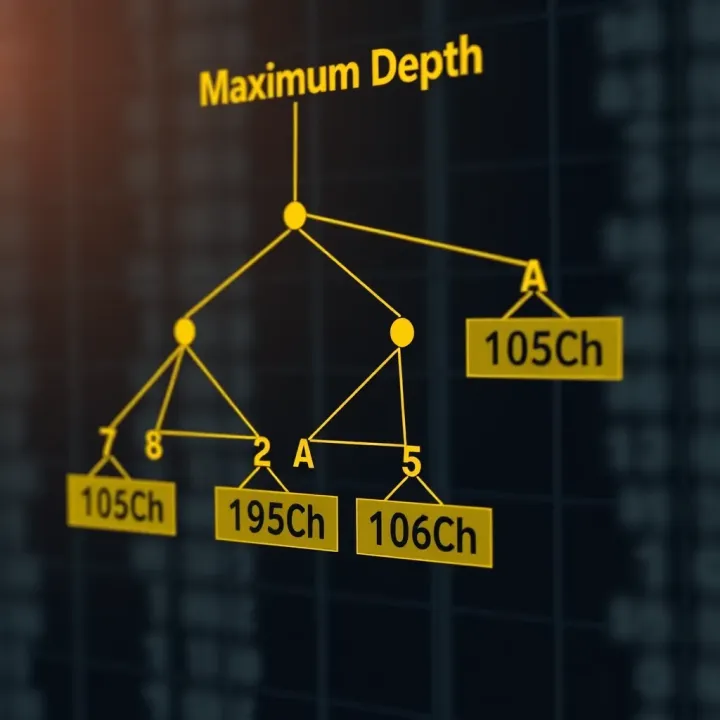
Understanding Maximum Depth of a Binary Tree
Explore how to find the maximum depth of a binary tree 🌳 with practical methods like recursion & iteration, including edge cases & optimization tips.
Edited By
Oliver Thompson
In computer science, understanding the structure of data is key, especially when working with trees. A binary tree is a fundamental structure where each node has up to two children, often referred to as the left and right child. The depth of a binary tree is a crucial parameter that reflects how many layers or levels the tree has from the root down to the furthest leaf node.
Binary tree depth often gets mixed up with similar terms like height and level, but it has its specific meaning. Depth typically refers to the longest path from the root node to any leaf node, measured in the number of edges or nodes depending on the context. For instance, in a binary tree representing stock price movements, the depth might show the longest chain of decision points affecting the final price outcome.
Calculating the depth can be straightforward with recursive methods. By traversing each subtree and noting its depth, you identify the maximum depth between left and right children and add one for the current node. This simple approach helps traders or analysts understand the complexity of decision trees or algorithmic structures that influence trading models.
Knowing the depth of a binary tree helps you gauge the complexity of hierarchical data, be it for stock trends, financial decision trees, or algorithm design.
Some practical applications where depth matters:
Decision Trees in Trading: Depth impacts model complexity and can influence overfitting or underfitting.
Portfolio Analysis: Hierarchical clustering uses tree depth to show asset grouping layers.
Order Book Structures: Depth helps visualise market orders organized by price levels.
Understanding depth aids in optimising algorithms, since a deeper tree may require more complex traversal or pruning techniques, which can affect performance when processing large volumes of financial data.
In upcoming sections, we’ll break down the methods to calculate depth, distinguish between height and level, and explore optimisation tips relevant to the financial domain.
Understanding the concept of binary tree depth is fundamental when dealing with data structures that model hierarchical relationships, such as decision trees in finance or transaction logs in blockchain systems. Depth essentially measures how many layers a binary tree extends downward from its root. Knowing this helps in optimising algorithms that traverse these structures, impacting speed and memory usage.
A binary tree consists of nodes where each node has at most two children, generally referred to as the left and right child. This simple yet powerful structure represents data in a hierarchical manner, such as a company's portfolio categorisation or nested market segments. The root node represents the top-level element, often the earliest or most significant data entry.
It's important to distinguish between depth, height, and level in a binary tree:
Depth of a node is the number of edges from the root node down to that particular node. The root itself has a depth of zero.
Height refers to the longest path from a node to its furthest leaf descendant. For the whole tree, height is the depth of the deepest node.
Level denotes the layer where a node resides, typically starting from 1 at the root.
Confusing these terms can lead to errors in traversal and calculation, affecting algorithm outcomes.
Depth plays a direct role in tree traversal methods like preorder, inorder, or postorder — each of which traverses nodes based on their depth and position. For instance, in determining the quickest access path to a stock's historical data, algorithms account for node depths to avoid unnecessary scanning.
Moreover, the depth affects computational efficiency and resource management. A deep tree can slow down access times and increase storage needs, impacting real-time decision-making in trading platforms or portfolio analysis software. Balanced trees, which keep depth shallow, contribute to faster searches and updates.
Understanding the depth of binary trees allows developers and analysts to predict algorithm performance better, manage data efficiently, and design balanced structures that suit their specific use cases.
In summary, grasping what binary tree depth means and how it differs from related terms prepares you for optimising data operations that depend on these fundamental structures.
Knowing how to calculate the depth of a binary tree is key for analysing its structure and efficiency. This measure affects how algorithms perform, especially those involving search, insertion, or deletion. Two main methods—recursive and iterative—offer practical ways to determine depth, each fitting different scenarios.
The recursive method uses the natural structure of trees for a straightforward calculation. The idea is simple: depth of a node is one plus the greater depth of its left or right subtree. This fits well with the divide-and-conquer style common in tree algorithms.
For example, to find the depth of the entire tree, start from the root node. Recursively traverse left and right subtrees, compute their depths, then pick the maximum. This directness makes the recursive method easy to implement and understand.
A typical code outline involves a function that calls itself for left and right children until it reaches a leaf node (base case). Returning zero for null nodes ensures the recursion stops properly. This approach mirrors how trees are naturally defined.
However, recursion can eat up stack space, especially for very deep or skewed trees. Time complexity is generally O(N), with N as the number of nodes, because each node is visited once. Space complexity equals recursion depth, which in worst cases can be O(N) as well.

Iterative methods rely on breadth-first search (BFS) with the help of queues. Here, the tree is explored level by level, making it easier to measure depth without recursion.
The process starts by enqueuing the root. Then, nodes are dequeued level-wise, and their children enqueued. Counting the number of levels processed gives the depth directly.
Stepwise, you:
Insert the root node into a queue.
Loop while the queue is not empty.
At each iteration, process all nodes at the current level.
For each node, enqueue its children.
Increment the depth counter after processing each level.
This BFS approach works well for balanced trees and avoids recursion-related stack overflow risks.
That said, iterative methods need extra memory for queue storage, which depends on the maximum number of nodes at any level. For wide trees, this can be significant but usually manageable.
Trade-offs between recursive and iterative methods boil down to tree shape and resource constraints. Recursive calls offer elegant code but risk stack overflow with deep trees. Iterative traversal uses more explicit memory but controls depth counting reliably.
Choosing the right calculation method depends on your tree's characteristics and the programming environment's constraints.
In programming contexts, especially in financial algorithm analyses or data structure implementations, understanding these methods helps optimise search and update operations tied to depth. Both techniques support accuracy and efficiency when handling large or complex binary trees.
Understanding the depth of a binary tree is not just an academic exercise; it directly influences performance and efficiency in programming. Depth plays a vital role in how data structures behave, affects recursion limits, and ultimately shapes the responsiveness of software applications, including those analysing stock data or handling large financial datasets.
The depth of a binary tree is critical in self-balancing trees like AVL and Red-Black trees. These trees maintain balance by restricting how deep certain branches can become after insertions or deletions. For example, AVL trees rebalance whenever subtree heights differ by more than one, preventing extreme depth growth. This balance ensures operations such as search, insert, and delete stay close to O(log n), preventing worst-case scenarios of linear time complexity that appear in skewed trees.
Red-Black trees follow a similar idea but allow slightly more flexibility, maintaining balanced depth through colour-coding nodes and enforcing rules on node colours to guarantee the tree remains relatively balanced. The key takeaway is how limiting excessive depth enhances data access speed and durability, which is crucial when working with real-time financial data or high-frequency trading systems where delays in data retrieval can cost heavily.
Balanced depth reduces the average number of comparisons needed to find an element. Since the time complexity for search depends largely on the tree depth, flatter trees allow quicker navigation. For instance, a balanced binary search tree of depth 20 can manage over a million nodes while still keeping search operations efficient.
In practical scenarios like financial software handling vast datasets, such as stock prices or transactions, balanced trees help maintain fast query responses. This efficiency contributes directly to better user experience and reduced computational load, which is especially important for software serving millions of users or processing real-time analytics.
Recursive algorithms often mirror the structure of binary trees, with function calls diving down levels. The depth of the tree guides recursion depth; deeper trees imply longer recursive chains. Understanding this depth helps developers set safe recursion limits to prevent performance bottlenecks.
For example, in portfolio risk calculations where recursive methods model dependencies, hitting the default recursion limit might halt the program unexpectedly. Knowing the expected depth lets programmers anticipate and adjust recursion limits accordingly, or adopt alternative strategies to handle deeper trees.
Stack overflow, a common error in recursion, happens when too many nested calls exhaust memory. Large tree depths increase this risk since each level of recursion adds a stack frame.
Efficient depth management can prevent such crashes. Techniques include rewriting recursive solutions iteratively using stacks or queues, splitting large problems into smaller parts, or applying tail recursion with compiler optimisations. For financial analysis tools that run complex calculations on huge datasets, avoiding stack overflow safeguards continuous service, even under heavy loads.
A firm grip on binary tree depth is essential not just for algorithm design but to ensure smooth, efficient execution in demanding real-world applications like stock market analysis and data-driven trading platforms.
Working with binary tree depth can bring several obstacles, especially when trees grow large or become skewed. These challenges impact algorithm efficiency and accuracy in depth calculation. Addressing these issues not only improves performance but also reduces bugs, which is key for anyone dealing with data structures, trading algorithms, or complex problem-solving in technology.
Effect of skewed trees on depth: Skewed trees occur when nodes predominantly extend on one side—left or right—resulting in a tree that resembles a linked list more than a balanced binary tree. This skew increases the depth significantly, often reaching the number of nodes in the worst case. For example, if you insert ascending stock prices one after another into a binary search tree without balancing, you might end up with such a skewed structure. This deepened tree impacts performance, as traversal or search operations become linear rather than logarithmic, negating binary tree advantages.
Strategies to manage imbalance: To handle imbalance, developers often use self-balancing binary trees like AVL or Red-Black trees. These trees automatically adjust themselves during insertions or deletions by rotations, keeping the depth logarithmic relative to the number of nodes. This balancing improves search times and reduces memory overheads in recursive calls. For traders or analysts managing large datasets, opting for balanced trees ensures real-time data processing without delays caused by excessive depth.
Off-by-one mistakes: A frequent error in calculating depth comes from counting nodes versus edges incorrectly. Depth typically counts the number of edges from the root to a node. Some mistakenly count nodes, resulting in numbers that are off by one. For instance, in recursive implementations, forgetting to add one for the current node’s depth or incorrectly initialising the base case may cause such mistakes. These errors lead to incorrect depth values, which can misguide algorithm behaviour.
Confusing depth with height: Depth and height often get mixed up. Depth of a node is the distance from the root to that node, while the height is the longest path from the node to a leaf. This mix-up is common among beginners and even intermediate programmers, causing flawed logic in applications like balancing or traversal. Accurate understanding guarantees proper tree manipulation and optimises performance, especially when working with trees designed to maintain balance.
Testing and debugging tips: Rigorous testing helps catch these errors early. Use small sample trees where you can manually verify the expected depth. Integrate assertions in your code to check if the computed depth or height matches expected values during tree traversals. Debugging becomes easier by printing intermediate values during recursion or iterative traversals to track miscalculations. Tools supporting visualisation of trees can help ensure the structure corresponds to your calculations.
Understanding these challenges and their solutions ensures your application handles binary trees effectively, minimising runtime issues and delivering precise results in data-sensitive environments like financial analysis and algorithmic trading.
Always validate the size and balance of your trees when working with large datasets.
Prefer balanced tree implementations to maintain efficient depth.
Be mindful of off-by-one and terminological errors in depth calculation.
Use sample-driven testing and visualisation tools for debugging.
By keeping these points in mind, you improve both the logic and performance of your binary tree-related code, ensuring better outcomes for complex and data-heavy tasks.
Understanding the depth of a binary tree is central to optimising many programming tasks, especially in data handling and algorithm design. This section pulls together key ideas discussed earlier, highlighting practical approaches and pitfalls to avoid. Grasping these concepts can save significant time and reduce errors during development, particularly when dealing with complex or large-scale tree structures.
Calculating the depth of a binary tree involves either recursive or iterative techniques. The recursive method follows naturally from the tree structure: it explores each branch deeply and returns the maximum depth found. This approach suits most cases with small to medium trees but can suffer from stack overflow in extremely skewed or deep trees. On the other hand, iterative methods typically use level order traversal with a queue to track nodes level by level, offering better control over memory usage and handling wide trees more efficiently.
These methods are practical in scenarios like real-time data queries or constructing balanced trees, where accurate depth calculation directly impacts performance. For example, depth calculation helps balance AVL trees, ensuring faster search, insert, or delete operations.
Depth isn't just a number—it often determines the efficiency of tree operations. A shallow, balanced tree results in quicker searches because the number of comparisons reduces substantially. Consider stock trading applications where decision trees are used to evaluate options; a balanced structure ensures faster execution, crucial in volatile markets.
Moreover, depth influences memory consumption during recursive calls and plays a role in avoiding stack overflow errors, especially with large financial datasets parsed through trees. Developers must keep these impacts in mind while designing or selecting data structures for their applications.
Selecting the optimal depth calculation method depends on the tree's expected shape and size. If your tree is unlikely to become highly skewed, recursion offers clarity and simple implementation. Conversely, for potentially large or unbalanced trees—common in dynamic financial data environments—iterative methods prevent deep call stacks and handle memory better.
Be aware of edge cases such as empty trees or single-node trees; your approach should handle these gracefully. Experimenting with both methods on sample data can reveal which suits your use case best without impacting performance.
Numerous libraries ease the handling of binary trees and their properties. In languages like Python, libraries such as NetworkX provide graph and tree utilities including traversal and depth calculation. Java’s Collections framework includes TreeMap and TreeSet, which internally manage balancing, thus implicitly controlling depth.
Leveraging these tools reduces manual coding effort and the risk of errors in depth-related calculations. For financial or trading platforms, choosing libraries with proven stability and community support ensures reliability under heavy loads or complex queries.
Proper handling of binary tree depth not only improves algorithm efficiency but also helps maintain software robustness, a must for high-stakes applications like trading platforms or investment analysis tools.
Explore how to find the maximum depth of a binary tree 🌳 with practical methods like recursion & iteration, including edge cases & optimization tips.
Explore how to calculate the maximum depth of a binary tree 🌳, understand common challenges, and learn practical uses for programming and data structures.

💻 Understand binary numbers, how they work, convert between binary & decimal, and explore their practical use in computing and programming today! 🔢
🌳 Learn how to measure the maximum height of a binary tree in programming. Explore recursive & iterative methods, impacts on structure, and key challenges.
Based on 7 reviews